What BGP shows during the 2026-11-18 SMW5 cable fault
On 2026-11-18, Cloudflare Radar reported that HTTP traffic in Pakistan dropped as much as 36% below its normal level around midday, and attributed the degradation to a major submarine cable failure. The Pakistan Telecommunication Authority reported a fault on the SEA-ME-WE 5 (SMW5) submarine cable about 11 km off Pakistan’s shore, saying the fault could cause intermittent connectivity problems and reduced service quality for some users, while Transworld Associates (TWA, AS38193) was coordinating with the SMW5 consortium and traffic was rerouted over alternative international links. Cloudflare measured HTTP traffic; the routing data below measures route announcements and prefix visibility. The public BGP data from that day shows increased AS38193 announcements and prepending toward Sparkle and Cogent, consistent with traffic engineering, and it also shows how little the prefix counts moved.
Key points
- Announcements carrying AS38193, summed across 78 collectors, ran at 14,416,902 on 2026-11-18, against a median of 3,842,549 over the 13 preceding days, and 67 of the 103 slots between 12:30 and 21:00 UTC beat the same slot’s highest value from those 13 days.
- AS38193 prepended its own ASN, two or more consecutive copies, in 1,323,375 announcements, 9.2% of the day’s AS38193 total; in 83% of those the ASN immediately before the repeated block was Telecom Italia Sparkle (AS6762, 641,503) or Cogent (AS174, 462,054).
- Replaying the day’s updates on the 00:00 UTC RIB, all but two of the 8,896 Pakistani prefixes whose median collector count before 12:30 UTC was at least five stayed at or above half that median in every replay slot. Across the 76 collectors, the two exceptions are one /48 that dropped from 47 collectors to 21 and was back above 47 by 20:20 UTC, and one /24 last seen at 17 collectors in the 11:45 UTC slot and absent from every slot after it.
Timeline
The churn starts in the 12:40 RIS file and runs to 21:00. The unit throughout is one BGP announcement: one prefix carried in one UPDATE message from one peer, summed across 78 RIPE RIS and RouteViews collectors and keyed to the update file’s start time (RIS every five minutes, RouteViews every fifteen). All times UTC, and an announcement count is churn, not traffic. Before 12:30 UTC (17:30 Pakistan time) the announcement rate through AS38193 sits near its normal level. Hourly ratios from 12:00 through 20:00 are 5 to 15 times the same hour’s 13-day median, except at 18:00 where the hour runs at 2.5 times. Recovery starts at 21:00 (1.25 times), then 1.4 at 22:00 and 0.7 at 23:00. The peak slot is 19:45 with 717,459 announcements.
Figure 1. Announcements whose AS path contains AS38193 in each update-file slot of 2026-11-18 (blue), summed across 78 collectors, against the minimum to maximum range of the same slot on the 13 preceding days (grey band). The dashed line marks the 12:30 slot.
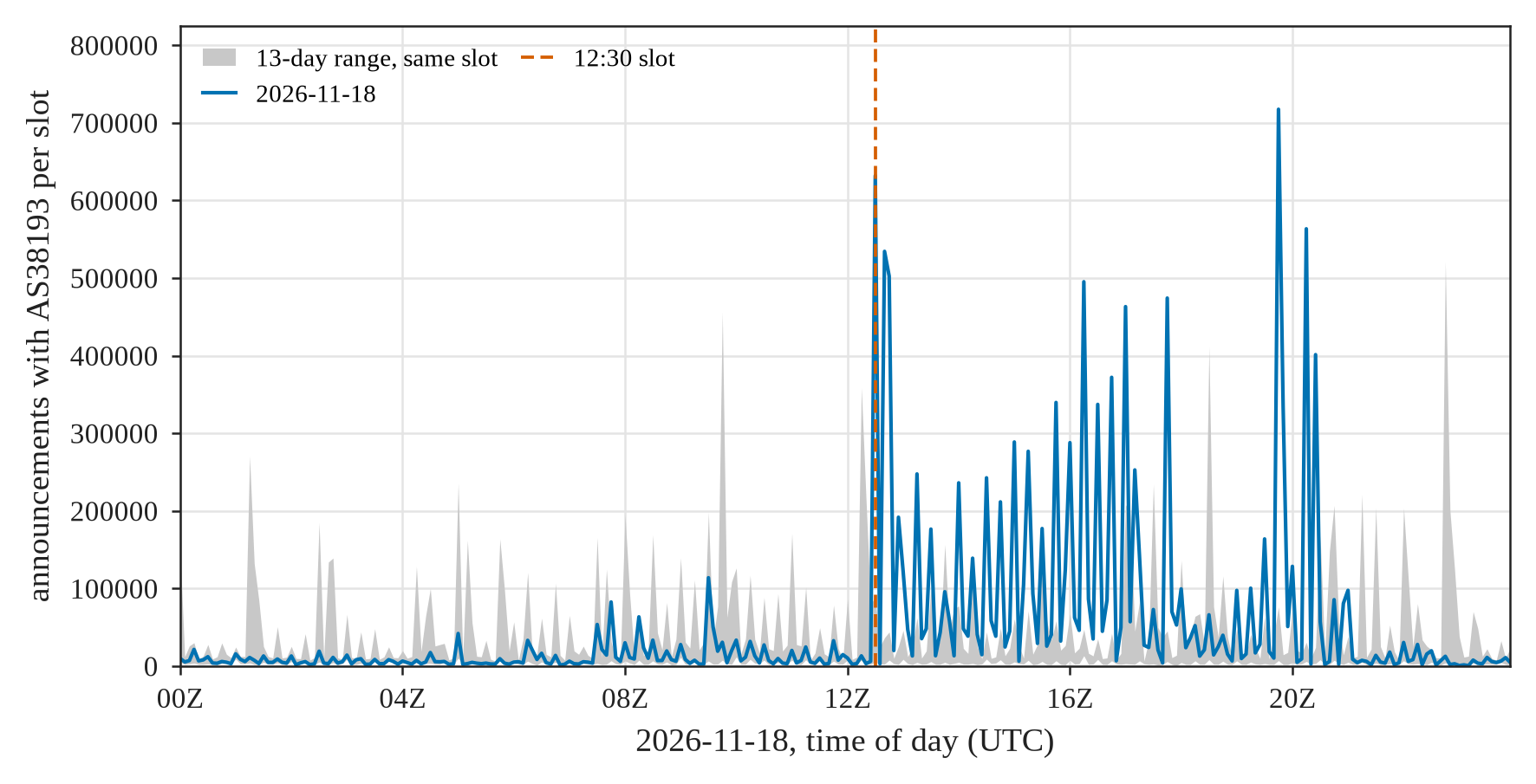
The 12:30 slot is where the 78-collector series jumps, but it is a mixed bucket: most of its value comes from RouteViews files that cover 12:30 to 12:45. The RIS five-minute files resolve the timing: 2,979 announcements in the 12:35 slot, 534,373 in the 12:40 slot.
At RIPE RIS collector rrc25, the 12:40 file carries 18,114 announcements for origin AS45669 (Mobilink/Jazz), 127 distinct AS paths from 28 peer ASNs, covering 612 prefixes. That is one origin’s routes arriving with many path variants. Comparing it with the 12:30 file is not a controlled before-and-after, because the vantage changes: 317 prefixes from one peer ASN at 12:30, 612 prefixes from 28 peer ASNs at 12:40.
Prepending toward Cogent and Sparkle
Every announcement carries an AS path, and a withdrawal carries none, so this series holds announcements only and says nothing about withdrawals. What it does show is AS38193 prepending its own ASN, up to ten consecutive copies in one path, in 1,323,375 announcements that day.
Figure 2. Announcements whose AS path repeats AS38193 back to back, per hour across 2026-11-18 (00:00 to 23:59 UTC), split by the ASN immediately in front of the repeated block: Cogent (AS174), Telecom Italia Sparkle (AS6762), and all other upstreams. The rise starts in the 11:00 hour and the large values stop after 20:00.
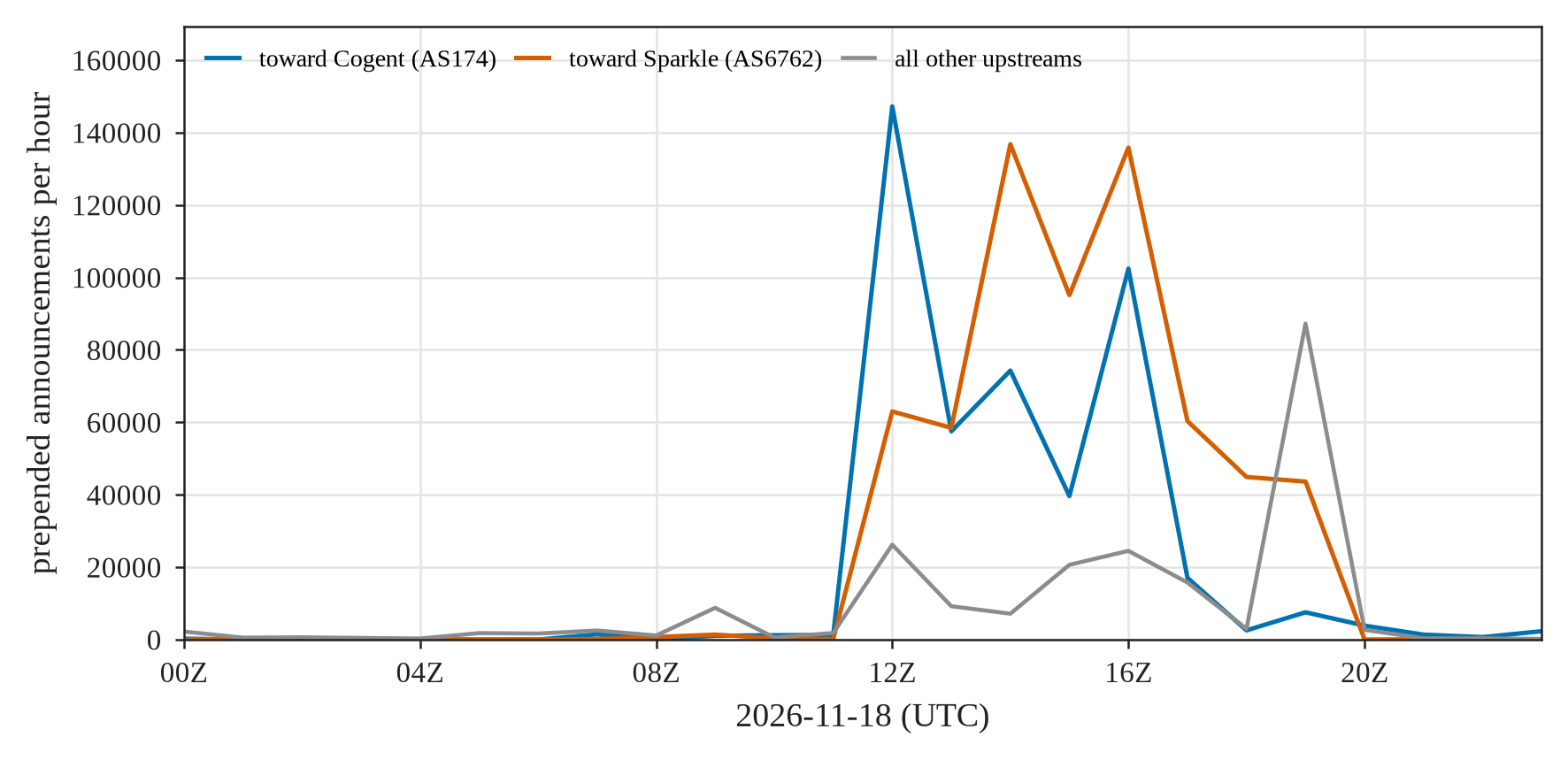
Classifying each of those by the ASN immediately in front of the repeated block puts Sparkle at 641,503 and Cogent at 462,054, so the two western providers carry 83% of the prepending. Prepending toward a transit provider makes those paths less attractive to inbound traffic, all else equal and unless local preference overrides it, without withdrawing anything. That is the shape TWA’s announcements took for most of the event, though other upstreams carry prepended paths in some hours.
The 13 days before the event have a median daily count of 69,733 prepended announcements. The event day carried 1,323,375, 19 times that median and 5 times the busiest other day (263,091 on 2026-11-11).
TWA, PTCL and two control origins
Among the three series compared here, only TWA ran far above its own normal. Normalizing each series against its own median for the same time of day over the 13 preceding days gives, for the 12:30 to 21:00 window, a median multiple of 6.8 for announcements through AS38193, 1.3 for those through PTCL (AS17557), and 0.9 for the control.
Figure 3. Median multiple of each series’ own same-slot median over the 13 preceding days, computed on announcements summed across 78 collectors, for 12:30 to 21:00 UTC on 2026-11-18: AS38193 (TWA), AS17557 (PTCL) and the control AS9541+AS56167. The dashed line at 1 marks each series’ own normal at that time of day.
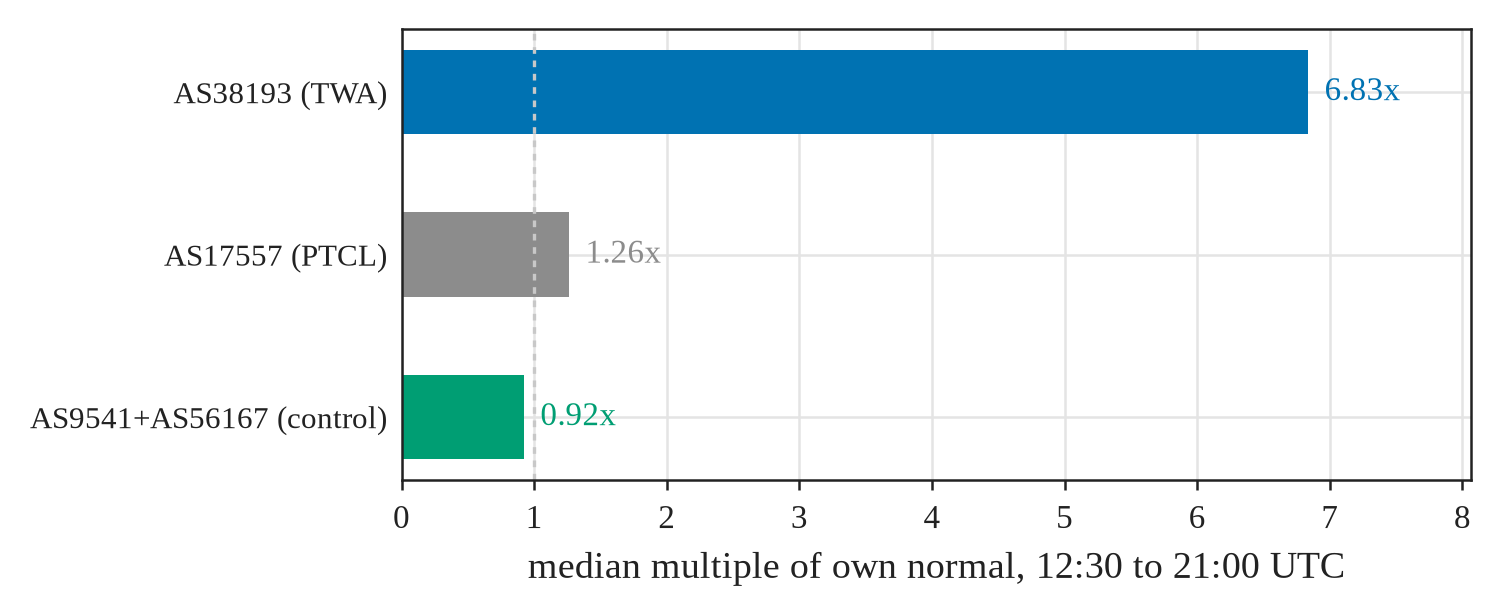
The control is AS9541 (Cyber Internet Services) and AS56167, two Pakistani origins with no AS38193 path in the 2026-11-18 00:00 or 2026-11-19 00:00 RIB, and the median multiple of their combined series across the window was 0.92. PTCL is not an independent comparison: 1,359,507 of the 4,736,454 announcements through AS17557 in the window, 29%, belong to six origins that also transit AS38193 (AS45669, AS58470, AS23674, AS59257, AS38264 and AS23966), so the two series share origins.
One more negative check: RIPE RIS collector rrc26 in the United Arab Emirates peers directly with AS17557. Across the 2026-11-18 10:00 to 22:00 UTC update files it logged 2,651 session state changes and none for AS17557, which is consistent with no reset of the PTCL session at that collector.
Visibility, checked as a series
Two midnight RIB snapshots cannot show what happened between them. So we replayed the day on the 76 collectors that carry Pakistani origins: the 2026-11-18 00:00 UTC RIB as the initial state, then that day’s per-file announcement and withdrawal counts applied file by file in slot order, per prefix, collector and peer. A prefix counts as visible on a collector when at least one peer carries it there. That yields the number of collectors showing each Pakistani prefix at every five-minute slot.
Of the 8,896 prefixes whose median collector count before 12:30 UTC was at least five, two fell below half that median at some slot. 2401:8e00:3800::/48 sat at 47 collectors through 12:30, fell to 28 in the 12:35 slot and to 21 from 12:45, and was back above 47 by 20:20, ending the day at 58. 172.41.33.0/24 sat at 17 collectors through 11:45 and at none from 11:50, and never returned; the withdrawal records name peer AS49544 and peer AS14537 across 17 collectors, which does not establish whether a session ended or whether the origin withdrew the route. A single /24 leaving is consistent with ordinary churn and says nothing about the cable. These timestamps name the slot at which the state changes, not the exact moment inside the five-minute RIS or fifteen-minute RouteViews file.
The same day at two-hour resolution, from twelve route-views2 RIB snapshots, gives a different view: 7,172 Pakistani prefixes appear at some point, three are present at 00:00 and absent at 22:00, one is missing only at 14:00, and five are new. That is one collector, so it cannot measure a drop across 76, and the prefix missing at 14:00 is the intraday absence two midnight RIBs would miss.
The midnight snapshot comparison, for the record: on the 76 collectors that carry Pakistani origins in both, total Pakistani-origin prefixes moved from 9,133 to 9,117 between 2026-11-18 00:00 and 2026-11-19 00:00 UTC, and prefixes reachable through AS38193 from 4,080 to 4,010. Those two numbers are consistent with the replay; they simply cannot show when anything moved.
What to take away
- From 12:00 through 20:00 UTC, hourly announcements through TWA ran at 5 to 15 times the same hour’s 13-day median except at 18:00, which ran at 2.5 times, while the Pakistani prefixes in the two midnight RIBs moved from 9,133 to 9,117.
- The clearest signature was AS path prepending: 9.2% of the day’s AS38193 announcements carried at least two consecutive AS38193 entries, and 83% of those were sent toward Cogent and Telecom Italia Sparkle.
- The reported fault came with control-plane churn rather than a broad visible routing outage in this replay: only two of the 8,896 Pakistani prefixes with at least five baseline collectors ever fell below half their own pre-event median, and one of them did so before the event window.
- The two Monocle search commands below reproduce the element-level counts from public rrc25 files with no account; the 78-collector sums, the 13 baseline days, the midnight RIB totals and the replay are not reproducible from them.
Reproduce it yourself
Both tools are open source and need no account. monocle search looks up the public files through the BGPKIT Broker and filters them in one step, so each check below is a single command.
Count origin AS45669’s announcements in the rrc25 file that starts at 12:40 UTC (unix 1795005600):
monocle search -c rrc25 -t 1795005600 -d 5m -o 45669 --format json-line \
  | jq -sc '{lines: length, peers: ([.[].peer_asn]|unique|length),
             paths: ([.[].as_path]|unique|length), prefixes: ([.[].prefix]|unique|length)}'
Expect one line:
{"lines":18114,"peers":28,"paths":127,"prefixes":612}The same command with -t 1795005000 for the 12:30 file returns {"lines":1278,"peers":1,"paths":7,"prefixes":317}, which is the vantage change the timeline describes.
List the paths that repeat AS38193 in the 12:30 file:
monocle search -c rrc25 -t 1795005000 -d 5m -a '38193 38193' -f timestamp,prefix,as_pathExpect two lines, both this path at 1795005100:
1795005100|119.73.101.0/24|142289 9583 2914 6762 38193 38193 38193 38193 38193 38193 38193 135407That is an announcement from origin AS135407 arriving through Sparkle (AS6762), with AS38193 repeated seven times as transit.
The two commands do not reproduce the 78-collector sums, the 13 baseline days, the two midnight RIB totals or the 76-collector replay, each of which needs more than one file: more collectors, more days or the update stream.
Limits
Public BGP feeds record control-plane signaling only: which prefixes operators announce, withdraw, or send with a longer AS path. They do not measure packet volume, link utilization, latency, user experience, or physical cable damage.
These records do not establish where the cable was damaged, and they do not prove that SMW5 caused the prepending rather than concurrent maintenance. That link rests on timing and the PTA notice naming TWA as coordinating with the SMW5 consortium. Routing data also says nothing about traffic volume, congestion, or what subscribers experienced. The replay infers visibility from the update stream, so its resolution is five minutes only for RIS collectors and fifteen for RouteViews, and it works from per-file counts, so an announcement and a withdrawal of the same route inside one file are applied as an announcement, not in their true order. Treat the replay as a slot-level estimate, not an element-ordered reconstruction.